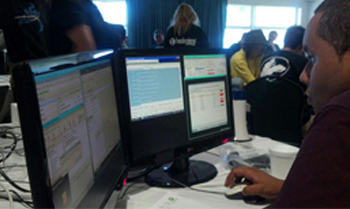
At 3pm we will have a presentation by Christopher Triana on using DD-WRT & OpenWRT to hack router firmware. The presentation will focus on uses, modification, and exploitation of misconfigurations. Christopher Triana is a local security researcher and member of HackMiami.
Afterwards, we will also be featuring a presentation by Peter Greko on using perl scripts to assist in wordfile creation for use in brute force dictionary attacks. Peter Greko is a local security researcher, application analyst, and member of HackMiami.
After the presentations we will have a lab where we will be hacking router firmware and installing DD-WRT & OpenWRT, as well as the usual bouts of malware reverse engineering, web app / infrastructure hacking, lockpicking, and more.
Everyone is welcome, n00bz and 1337z alike!
January 30, 2010
1pm – 6pm
Florida International University – ECS 280
11200 SW 8th Street
Miami, FL
This Saturday we will get together for an afternoon of educative destruction where we will be disassembling old or busted electronics and salvaging parts for new projects (and as a side effect, learning a bit more about how these things are put together).
You don’t need to bring anything, we will provide soldering irons, desoldering copper braids, and plenty of stuff to take apart. That said, if you have old busted electronics that you would like to get
rid of, feel free to bring them with you. In the past we have taken apart CD drives, routers, VCRs, printers, scanners, and even a belt sander.
We will also be having a presentation on Windows 7 Security by Jorge Orchilles at the beginning of the afternoon.
As always, you can just work on your projects, read, study, or just hang out.
The details:
WHERE: FIU (University Park Campus), ECS 280
WHEN: Saturday, September 5
TIME: 1 – 6 PM
As a result of last Saturday’s Hack-a-Thon, Latrokles finished up the first version of his speech recognition and synthesis library for openFrameworks. As a wrapper around the speech APIs in OS X, it only works on the mac at the moment, but there are plans to begin porting the same functionality over to windows and linux. There is also future functionality in the pipeline.
The lib could be used without openFrameworks with minimal tweaking, in the future there will be no tweaking necessary to use with or without oF.
Here’s a short video showing some of the library functionality.
Today is world Scratch Day. Scratch is a project from the MIT Media Lab, a programming language that makes it easy to create interactive stories, games, animation, etc. It was designed to get kids involved in programming and to teach them the fundamental ideas behind computation and mathematics while allowing them to play around and work creatively. For more information, visit scratch.mit.edu
Jeremy Conn created, with in a matter of minutes, a full fledged pong game using Scratch with collision detection, score keeping, and a simple AI.
At the 3/7/09 Saturday Hack-a-Thon, James was able to bring by a batch of solar panels and its related equipment. The panels and equipment were generously provided to us to play with for the day by Sun Electronics of Miami, FL.
We successfully powered a laptop using only the power of the sun. We will be doing much more with this technology in the near future.
Sun Electronics has a great online store of inexpensive high quality solar products. You can visit them at http://www.sunelec.com or call them at (305) 536-9917.
A few of us drove up to Orlando, FL for the annual ham radio convention called Hamcation organized by the Orlando Amateur Radio Club. If you’ve never been to a ham radio convention I highly recommend it. Especially one of this size. It’s pretty much a flea market of radio, computer, electronics components and an exhibit of antique radio equipment. It’s also a chance to meet old friends you usually only talk to over the airwaves. We spotted the Cheshire Catalyst manning the Linux distro booth.
There was a lot of cool stuff at this convention. One item that we just had to video tape was this old morse code training device. It’s an all mechanical hand cranked device that was used by the U.S. Military to train radio personnel morse code. Again what’s cool about these conventions is while the vendor was demonstrating to us this device and older gentleman mentioned how he remembered using this device during the Korean War.
Below we have a magnetic card reader made at the HACKMIAMI labs. It reads track 2 found on most magnetic striped cards (i.e. credit cards, drivers licenses, and student ids). Something interesting to point out, while testing the equipment with an old student ID card from a local university we found out it holds the person’s social security number on the card. The SSN use to be the student ID number. I wouldn’t be surprised if other universities did the same. The magnetic card reader was made using a Sanguino (a beefy Arduino clone), an LCD found on SparkFun, and magnetic card reader from All Electronics.
This Saturday, Oct 18, 2008 at 1 pm at FIU we will be having our bi-weekly hack-a-thon! Do you have any electronics, computer programming, or other hacking projects you want to work on? Join us this saturday!
You can find the agenda wiki page here. If you want to teach something at the hack-a-thon just add it to the wiki!
We will be having a HACKMIAMI meeting on September 20, 2008 at 1:00 pm in ECS 280 at FIU. Same room we’ve been having them at. We will also be having the bi-weekly hack-a-thon and screening of a “The Last Hope” Talk. click here to discuss and see the list of talks that can be watched.